NEDIC has developed a set of 14 age-appropriate posters for use in elementary, middle, and high schools — all free to download.
Displaying posters designed to promote positive relationships with one's body and mental health throughout a school is a way to help create a nurturing environment for all students.
NEDIC offers support through live chat, phone, or e-mail.
Our helpline workers represent diverse personal and professional backgrounds; many have lived experience of an eating disorder. They will support you in the ways that you feel you need it most. That might look like sending over some resources for you to read, referring you to a community organization or professional near you who has training in eating disorders, or talking through some coping strategies.
We're also happy to be your listener, answer your questions, and connect you with further supports for anything else you might need help with. We will not tell you what to do or push you to take a specific course of action.
Live chat
Phone
E-mail: nedic@uhn.ca
Monday to Thursday
Friday
Saturday and Sunday
NEDIC’s work, from our helpline to prevention-based community education programming, is made possible through the generosity of our donors.
Eating disorders affect people of all genders, ages, classes, abilities, races and ethnic backgrounds. These complex disorders are serious, biologically influenced illnesses — not personal choices. Recovery from an eating disorder is possible.

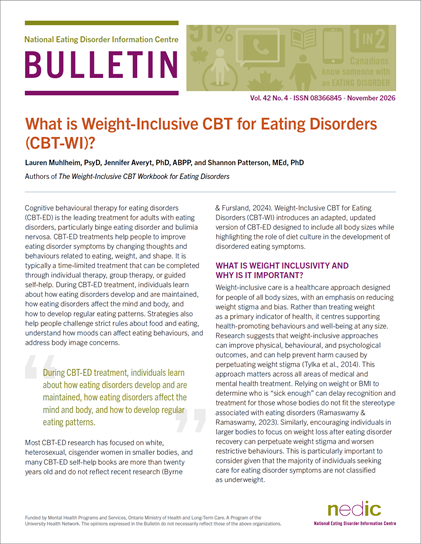
Cognitive behavioural therapy for eating disorders (CBT-ED) is the leading treatment for adults with eating disorders, particularly binge eating disorder and bulimia nervosa. Most CBT-ED research has focused on white, heterosexual, cisgender women in smaller bodies, and many CBT-ED self-help books are more than twenty years old and do not reflect recent research.
NEDIC is honoured to feature this contribution in the Bulletin, authored by Drs. Lauren Muhlheim, Jennifer Averyt, and Shannon Patterson, which introduces Weight-Inclusive CBT for Eating Disorders (CBT‑WI), an adapted, updated version of CBT‑ED designed to include all body sizes while highlighting the role of diet culture in the development of disordered eating symptoms.